Keywords: AI water risk, predictive water outage, utility risk AI
As climate variability intensifies and infrastructure ages, water utilities are facing a rapidly evolving landscape of operational and environmental risk. Artificial intelligence (AI) is emerging as a powerful tool to anticipate, manage, and mitigate these risks—particularly in the realm of water availability and service disruption. AI-driven water risk modeling is poised to revolutionize how utilities prepare for and respond to water outages, infrastructure strain, and climate-induced stressors.
Here’s what utilities need to know about integrating AI into their risk management and operational forecasting strategies.
- Understanding AI-Driven Water Risk Modeling
AI-driven water risk modeling leverages machine learning (ML), remote sensing, and advanced analytics to predict potential water-related threats—such as droughts, pipe bursts, contamination events, or demand spikes—before they occur.
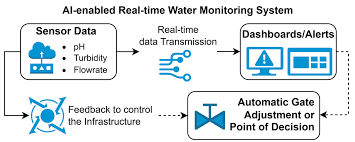
These models ingest vast volumes of historical and real-time data, including:
Hydrological and meteorological data (rainfall, temperature, snowpack)
Infrastructure conditions (pressure sensors, valve operations)
Consumption patterns (seasonal use, population trends)
Satellite imagery and geospatial data
Through pattern recognition and probabilistic forecasting, AI can identify vulnerabilities, simulate different risk scenarios, and offer actionable insights well in advance.
- Predictive Water Outage Management
AI enables a shift from reactive to predictive outage management. By identifying leading indicators of water system failures—such as pressure fluctuations or abnormal flow rates—utilities can intervene before outages occur.
Key use cases include:
Pipe failure prediction: ML models assess age, material, soil conditions, and flow anomalies to predict breakage.
Drought resilience modeling: AI forecasts long-term water availability using climate projections and consumption trends.
Real-time anomaly detection: Algorithms flag inconsistencies in water quality or distribution in real time, enabling rapid response.
Predictive capabilities reduce the duration and frequency of outages, minimize repair costs, and improve service reliability for end users.
- Mitigating Utility Risk with AI
From regulatory compliance to financial planning, utilities face multiple layers of risk. AI strengthens risk management by:
Enhancing decision-making: AI synthesizes complex datasets to guide strategic investments in infrastructure upgrades or conservation programs.
Supporting regulatory reporting: Predictive analytics help ensure that utilities meet environmental and service benchmarks.
Optimizing asset management: AI can prioritize maintenance schedules based on condition-based risk, extending the lifespan of infrastructure.
This strategic risk mitigation improves resilience, protects public health, and ensures operational continuity. - Challenges to Adoption
Despite its potential, integrating AI into utility operations presents challenges:
Data silos: Many utilities lack centralized, clean, and accessible data systems needed to train effective AI models.
Legacy infrastructure: Outdated equipment often lacks the sensors or digital connectivity required for real-time analytics.
Skills gap: AI implementation requires new expertise in data science and analytics, which many utilities are still building.
Regulatory uncertainty: Clear standards for AI use in critical infrastructure are still emerging, raising concerns about accountability and compliance.
Overcoming these hurdles requires partnerships with technology providers, investments in data infrastructure, and staff training. - Next Steps for Utilities
To harness AI-driven water risk modeling, utilities should:
Start with data readiness: Ensure data is accessible, interoperable, and cleansed for analysis.
Pilot use cases: Begin with targeted AI initiatives, such as leak detection or seasonal demand forecasting.
Invest in staff capabilities: Develop in-house expertise or partner with AI consultants to bridge knowledge gaps.
Collaborate across sectors: Work with municipalities, environmental agencies, and tech companies to ensure integrated, scalable solutions.
Conclusion
AI is not just a buzzword—it’s a critical enabler for resilient, sustainable water utility operations. By adopting AI-driven water risk modeling, utilities can transition from crisis response to strategic foresight, ensuring reliable water delivery in an increasingly unpredictable world.
For utilities facing growing climate and infrastructure pressures, the question is no longer if AI will play a role—but how soon and how well they can adopt it.