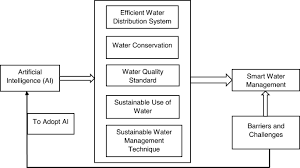
In an era marked by climate change and dwindling freshwater resources, the role of artificial intelligence (AI) in sustainable agriculture water management has become increasingly vital. As the global population grows, so does the demand for food production — putting immense pressure on water supplies used in agriculture. Fortunately, AI technologies offer innovative solutions to optimize water use, minimize waste, and improve crop yields through smart irrigation and precision farming water strategies.
AI-Powered Smart Irrigation Systems
Traditional irrigation methods often lead to overwatering, inefficient water distribution, and resource depletion. Smart irrigation systems, powered by AI, are transforming how water is managed on farms. These systems use real-time data from sensors placed in the soil and atmosphere to determine exactly when and how much to irrigate. AI algorithms process information such as soil moisture levels, weather forecasts, and plant water needs, allowing farmers to automate irrigation with precision.
This data-driven approach not only conserves water but also enhances plant health and productivity. By reducing runoff and avoiding water stress in crops, smart irrigation ensures sustainable agriculture water use that supports long-term farming viability.
Precision Farming Water Management
AI is a cornerstone of precision farming, where data analytics and machine learning guide decision-making on a micro-level. In terms of water management, AI tools can create detailed irrigation maps, predict drought risks, and assess water usage efficiency across different plots. These insights help farmers apply water exactly where and when it’s needed, preventing both over- and under-irrigation.
Drones and satellite imagery, combined with AI analysis, further support precision farming water strategies by detecting dry zones, monitoring crop health, and estimating evapotranspiration rates. This allows for adaptive water management that responds to changes in the field in real time.
Agriculture Water AI for Climate Resilience
One of the most pressing challenges in modern agriculture is adapting to unpredictable climate conditions. AI helps build resilience by enabling farmers to simulate different water management scenarios and forecast outcomes based on historical and current data. This predictive power is critical for making proactive decisions, such as altering planting schedules or switching irrigation methods in anticipation of droughts or floods.
Moreover, AI systems can be integrated with water distribution networks at the regional level to manage supply based on agricultural demand — ensuring equitable and efficient allocation of water resources.
Future Outlook
As technology advances, the integration of agriculture water AI solutions will become even more sophisticated and accessible. Mobile applications, cloud computing, and AI-as-a-service platforms are making it easier for farmers — even in remote or low-resource areas — to adopt smart irrigation and precision farming water techniques.
Public and private sector collaboration will be key to accelerating the adoption of AI in sustainable water management. Investments in digital infrastructure, farmer training programs, and supportive policy frameworks can unlock the full potential of AI in transforming agriculture into a water-efficient, climate-smart industry.
Conclusion
AI is not just a technological trend; it is a critical tool for sustainable agriculture water management. Through smart irrigation systems and precision farming water practices, AI empowers farmers to use water more efficiently, respond to environmental changes, and secure food production for future generations. Embracing these innovations is essential for building a resilient agricultural sector in a water-constrained world.