Harnessing Technology for Smarter Water Management in a Changing Climate
As climate change intensifies, communities around the globe are facing unprecedented challenges related to water—too much in the form of floods, and too little due to prolonged droughts. Traditional forecasting tools, often reliant on historical patterns, are proving insufficient in the face of rapidly shifting climate dynamics. In this context, AI-powered water forecasting is emerging as a transformative solution, enabling smarter, faster, and more adaptive responses to water-related climate risks.
Climate Water AI: A Game Changer for Forecasting
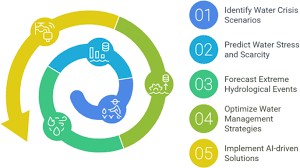
Climate water AI refers to the application of artificial intelligence to predict, manage, and respond to water cycle disruptions exacerbated by climate change. By integrating vast datasets—including satellite imagery, hydrological models, weather forecasts, and historical water usage—AI can detect patterns that human analysts might miss. This capability allows for real-time analysis and prediction of water availability and risks, offering a critical edge in climate resilience planning.
For example, deep learning models can simulate watershed behaviors under various climate scenarios, providing decision-makers with high-resolution, location-specific forecasts that are updated continuously. These tools not only enhance long-term planning for agriculture and urban development but also improve short-term response capabilities during extreme events.
Flood Prediction AI: Saving Lives and Infrastructure
One of the most life-saving applications of AI in climate resilience is flood prediction. With the increasing frequency of flash floods and extreme rainfall, traditional warning systems often fall short. Flood prediction AI leverages machine learning to forecast flooding with greater lead time and spatial accuracy.
These AI models synthesize real-time weather data, terrain information, river gauge readings, and urban infrastructure maps to create dynamic flood forecasts. Governments and emergency services are beginning to adopt these technologies to issue early warnings, coordinate evacuations, and deploy resources more efficiently. In developing countries, where infrastructure is limited and populations are highly vulnerable, these AI systems are proving to be particularly impactful.
Drought Mitigation Technology: Optimizing Water Use
On the other side of the water crisis spectrum is drought. Extended dry periods are threatening food security, energy production, and water supply for millions. Drought mitigation technology, powered by AI, is helping regions monitor, predict, and manage droughts more proactively.
AI models can analyze soil moisture, evapotranspiration rates, reservoir levels, and crop health using satellite data and IoT sensors. This information allows water managers and farmers to make informed decisions about irrigation scheduling, crop selection, and water allocation. In some regions, AI systems are even being integrated with blockchain to ensure transparent water rights management.
Moreover, AI can simulate various drought scenarios to guide infrastructure investments—such as aquifer recharge systems or desalination plants—based on projected long-term water stress.
Toward a Resilient Future
The integration of AI into climate water management is not a distant vision—it’s happening now. Tech companies, research institutions, and governments are partnering to create next-generation water forecasting platforms that blend meteorological science with machine intelligence. The goal is clear: to build resilience before disaster strikes, not just respond after.
However, realizing the full potential of climate water AI requires equitable access to data, responsible AI governance, and investment in local capacity-building. The ethical use of AI must go hand-in-hand with its technical capabilities, ensuring that communities—especially those most vulnerable—benefit from these innovations.
Conclusion
In a world increasingly shaped by climate volatility, AI offers a powerful toolset for protecting lives, ecosystems, and economies. Whether through flood prediction AI that issues timely alerts or drought mitigation technologies that optimize every drop of water, intelligent forecasting is key to climate adaptation. By embracing AI-driven water forecasting, we can move from crisis management to proactive resilience-building—ensuring a safer, more sustainable future for all.