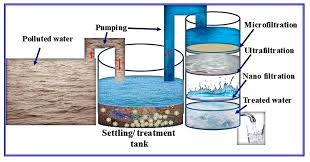
Water is an increasingly scarce resource, with natural reserves depleting rapidly. The United Nations Environment Program (UNEP) has identified around 2.4 billion people as living in areas identified as water-stressed, where more than 25 percent of renewable freshwater resources are utilized to meet local demands.
Regions particularly affected include Southern and Central Asia, as well as North Africa, where the situation is critical. Even countries with advanced infrastructure, such as the United States, are experiencing record-low water levels.
In response to this global challenge, governments are adopting drastic measures to secure safe and clean water for domestic and industrial purposes. Advances in water purification technologies, particularly through the development of new materials for water purification systems, are proving to be a pivotal solution. These innovations enhance cleaning efficiency and effectively remove harmful bacteria and chemicals.
These next-generation materials are shaping the future of the water purification industry and are essential for human survival in the future.
Advanced Materials in Water Purification
Experts have shown a growing interest in seamless covalent networks consisting of 2D graphitic carbon (G) sheets and 1D carbon nanofibers (CF) with hierarchical porosity. These structures are useful for various engineering applications, particularly in water purification systems.
These networks result from modifying natural precursors to develop modern, environmentally friendly, and sustainable filtration structures.
A recent breakthrough demonstrated the scalable fabrication of seamlessly interconnected, ultralightweight G and CF hierarchical aerogels from egg-white proteins without external templates.
The five mm-thick G-CF aerogels were tested by placing them over a funnel’s mouth and filtering seawater from the New Jersey shore at 0.5ml/min using gravity. After 50 filtration cycles through the G-CF aerogel, the filtered seawater was analyzed using inductively coupled plasma mass spectrometry (ICP-MS).
During the first cycle of seawater purification, approximately 13.1 % of Mg2+, 13.6 % of K+, and 17.9 % of Ca2+ ions were removed from the seawater. The ratio of salt ions decreased with each purification cycle.
By the end of 50 purification cycles, approximately 92 % of the ions were removed from the seawater. The salt adsorption capacity of the G-CF aerogels was determined to be around 32.6 g/g, which is higher than the average capacity reported previously.
The G-CF aerogel removed approximately 90 % of microplastics and other harmful substances from the water in the first cycle, achieving a 99.995 % removal rate of nano-plastic contaminants by the final cycle. The innovative method demonstrates a scalable and environmentally friendly approach based on the self-assembly of protein structures.
The chemical interconnection between graphitic carbon and CF structures significantly enhances the structural stability of the G-CF aerogels. This stability is crucial for maintaining consistent desalination and purification performance in modern filtration systems.
Among novel materials, nanostructured sorbents possess a high capacity for treating polluted water and can be customized to target specific pollutants.5 Recent advancements in polymer nanocomposites (PNC) have improved their effectiveness and expanded their use in water purification processes.
Simple and more affordable water filtration methods are gaining traction. These methods utilize recyclable, bio-based natural polymers such as chitosan, cellulose, and carbohydrate polymers, which are enhanced with nanoparticles, making them highly cost-effective and efficient.
Other biobased materials, such as porous resins, polyaniline, alginate, nanofibers, and cellulose nanofillers (CNFs), are also extensively utilized in water purification processes. Their application helps eliminate harmful substances from water, ensuring its safety for human consumption.
Polymeric adsorptive membranes are widely recognized as effective solutions for pollution remediation and have numerous applications in wastewater treatment plants and household water purification.