“Half of the lake will be covered by an algae bloom in a bad year.”
These are the words of one of the world’s leading experts on blue-green algae – a type of bacteria that can grow in lakes and rivers.
You would be forgiven for assuming he was referring to Lough Neagh, given how much it has dominated local headlines on this issue in recent months.
But he isn’t talking about the troubled freshwater lough in the centre of Northern Ireland.
Richard Stumpf – who leads the National Oceanic and Atmospheric Administration (NOAA)’s harmful algal blooms research team – is referring to the toxic algae bloom that has plagued Lake Erie in North America for decades.
Now the debate about Northern Ireland’s algae problem is shifting from how this happened, to what can be done about it.
Some academics and scientists here are looking across the Atlantic for potential solutions.
A perfect storm
The algae blooms in Lake Erie – which straddles part of the border between Canada and the United States – are arguably the world’s worst, and can cover an area the size of New York City.
In 2014, harmful algal blooms on the world’s 11th largest freshwater lake prompted the city of Toledo, Ohio, to issue a “do not drink” order for tap water that affected nearly 500,000 people for three days.
“We’ve been monitoring Lake Erie for 15 years, we track the blooms using satellite,” said Dr Stumpf.
“We are also able to collect data over Ireland and we could see the bloom in Lough Neagh in September this year was intense enough to equal the most intense part of the bloom in lake Erie.”
The algae blooms on Lake Erie are caused by a perfect storm of:
Warmer temperatures
Fertiliser use
An increase in heavy rainfall which flushes the fertiliser into waterways
Dr Stumpf and his team have been working on several environmentally friendly solutions.
He said: “We’ve been trying to control surface water run-off, things like buffers along fields such as wetlands and storm water retention ponds.
“Anything that can absorb the nutrients before they end up in the lake.”
Lough Neagh is the largest freshwater lake in the UK and supplies half of Belfast’s drinking water – and 40% of Northern Ireland’s overall.
The blue-green algal bloom over the summer has caused havoc, not just in Lough Neagh but right up to Northern Ireland’s north coast.
The bloom was the result of settled weather, invasive species and water pollution, mostly due to agriculture.
Excess fertiliser ran off fields into the water, carrying growth-stimulating nitrogen and phosphorus into the lough.
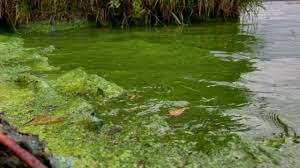
DAERA The blue-green algal bloom has been present in Northern Ireland this summer
It filters water, making it clearer and allowing the sun’s light to penetrate deeper into the depths.
That, combined with the excess nutrients from fertiliser – eutrophication – caused the algae to “bloom”, or grow rapidly.
NI Water has advised consumers that the water from all their water treatment works is safe to drink and use as normal.